The Scollay Square Subway Station
1870s - 1898; a bustling Square

After the removal of the Scollay Building (which gave the Square its name) traffic built along with post-Civil War population. By the 1890s Boston was in such terrible gridlock (does that sound familiar?) that the city approved a daring new idea - an railroad running UNDER the city's streets.
Plans afoot (to be underfoot)

Once the first section of Boston's (and America's) first electric subway was completed around the Common in 1897, work on the extension into Scollay Square and other points north began.
Cut and Cover

To mitigate the impact of building in a busy, working city, excavation and construction was executed several hundred feet at a time. When each section was done, it was covered up as excavation proceeded on the next several hundred feet.
Dig we must
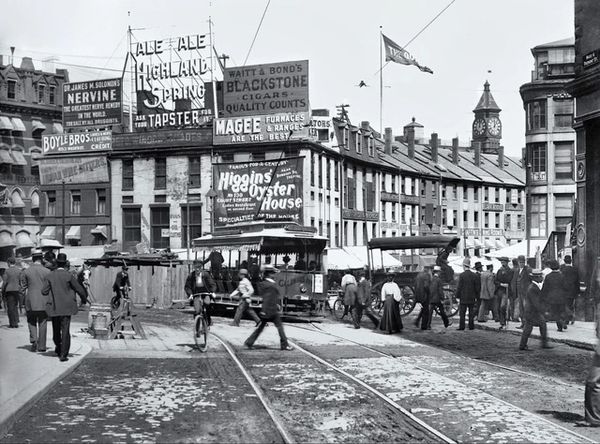
It's business as usual in Scollay Square despite it looking like a disaster zone during subway construction in August of 1897,
Better than a billboard?

This photo from 1897 shows a local business, whose entrance was blocked by construction, was allowed to post advertising on the fence along the tunnel .
A grand entrance

The completed Scollay Square station was a beautiful structure. Sheathed in granite with a copper roof, it was public works that was also public art .
Less than fifty years old, and out of date
The subway worked really well, but then some damn fool went and invented the automobile. Then a guy named Ford made them so cheap that in the 1920s it seemed like everyone had one. Now Boston, back in gridlock, was faced again with massive gridlock.
Not so grand, anymore

The solution was to widen several major thoroughfares, such as Cambridge Street, which ran through Scollay Square. Along with slicing the fronts of many buildings (notable the Crawford House) the not-yet-forty year-old elegant subway kiosk was removed and replaced with these decidedly inelegant holes in the ground.
The Cold War bunker
The new Government center @ Scollay Square station
The new Government center @ Scollay Square station
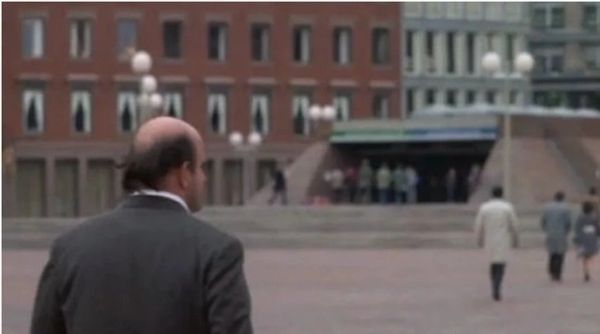
The Government Center project wiped away most of the Square. The new station, looking very much like a bunker (were designers inspired by Cold War fears?) was opened in 1964. (This picture, by the way, is from the end of The Friends of Eddie Coyle, one of my favorite films. We see Peter Boyle walking towards the station which replaced the kiosk on Cambridge Street.
The new Government center @ Scollay Square station
The new Government center @ Scollay Square station
The new Government center @ Scollay Square station
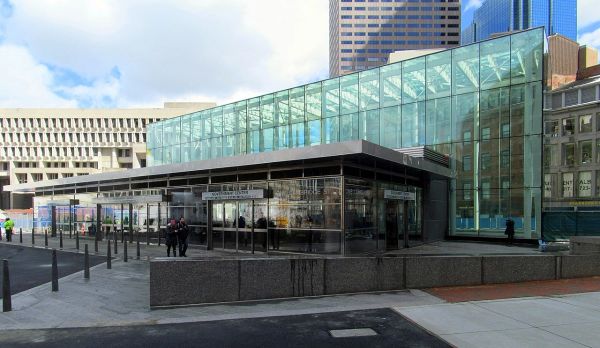
In 2016, after years of planning and several years of construction the new station for the Green and Blue lines at Government Center was opened. But this was more than just a rebuild, because the designers not only look forward but backward to the days when Scollay Square station was one of the system's busiest.
Before...

The first Scollay Square / Government Center stop was for the original underground trolley line to Charlestown. Just before World War One a station BELOW was added for a new line from East Boston, under the harbor, As we see in the original tiles the stop was called SCOLLAY UNDER.
After...

If you take the T I can't think of a better way to kill times in between trains than to walk around and see and even touch these wonderfully refurbished pieces of old Boston and Scollay Square.
Recycling

Unlike the 1927 and 1964 rebuilds, as part of this project, the T took great pains to use as much of the original tiled Scollay Square signs as possible.
The perks of being a writer
In November, 2014 I was invited to tour the site by Brian Howland, the project's Resident Engineer. I was flattered to learn from Brian that my books on the Square were used by the engineers and designers in their planning for the job. (Brian was kind to give me this piece of the original tilework. Thank you, Brian!


Railroad Gazette 1898


1898 article on subway construction


With apologies to Sheldon Copper
The fate of poor Charlie on the MTA is well known, thanks to the Kingston Trio and their hit version of a song originally written for a Boston mayoral candidate in 1947. In his 2000 book, The Eureka Effect: The Art and Logic of Breakthrough Thinking (W.W. Norton & Company) David Perkins presents paradoxes in physics. One of them involves an old friend from Scollay Square.
